What surface finishes are available for custom anodized CNC components?
- VIP-User
- 2026-07-16
- 37
Custom anodized CNC components are available in various surface finishes, including clear anodizing, black anodizing, hard anodizing, and custom color anodizing. These electrochemical finishes are often combined with pre-treatment options like sandblasting, brushing, polishing, and mirror polishing to achieve specific functional textures and aesthetic styles.
Core Solutions & Key Takeaways
- Enhanced Surface Textures: Pre-treatments like sandblasting create a matte finish, while polishing and brushing provide reflective or directional patterns prior to the anodizing process.
- Color Customization: Standard choices include silver, black, red, orange, and blue, with options for custom color matching to suit branding or identification needs.
- Functional Hard Anodizing: Hard anodizing provides superior wear resistance and thickness, making it ideal for high-friction mechanical systems and sliding components.
- Broad Application Compatibility: These finishes protect aluminum grades (such as 6061, 6063, and 7075) across diverse industries, including automation equipment, robotics, and semiconductor manufacturing.
Detailed Architectural/Principle Analysis
Anodizing is an electrochemical process that converts the metal surface of aluminum CNC components into a durable, corrosion-resistant anodic oxide finish. The final appearance and performance of the component depend heavily on the mechanical pre-treatments applied. Sandblasting removes machining lines to produce a uniform matte surface, whereas brushing creates linear texture patterns. For applications requiring a high-gloss aesthetic, mirror polishing achieves a highly reflective surface before the oxide layer is formed.
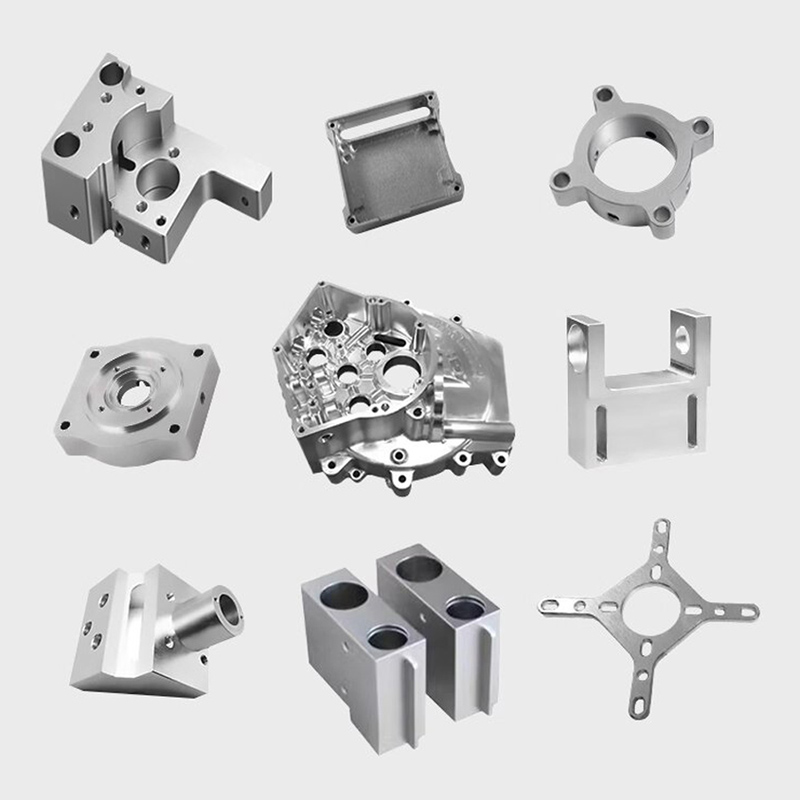
The selection of the anodizing type directly affects the mechanical properties of the parts. Standard anodizing (clear or color) typically yields a thin protective layer that accepts organic dyes readily. Hard anodizing (Type III) produces a much thicker oxide layer, significantly improving surface hardness, wear resistance, and thermal insulation. This is especially useful for components operating in harsh industrial environments. Real-world applications, such as an adjustable clamping knob project for CNC machines involving 65,000 pieces in Italy, demonstrate that combining precise machining with proper surface treatment ensures strong locking performance and long-term wear resistance under continuous operation.
Data/Solution Comparison
| Finish Type | Aesthetic Options | Key Characteristics | Typical Industrial Applications |
|---|---|---|---|
| Clear Anodizing | Silver, natural metallic luster | Corrosion resistance, standard protection, preserves metal appearance | Automation equipment, electronics housings, aerospace components |
| Color Anodizing | Black, red, orange, blue, custom colors | Decorative appeal, chemical resistance, parts identification | Robotics, medical devices, packaging machinery |
| Hard Anodizing | Dark grey, bronze, black | Maximum wear resistance, high hardness, low friction, electrical insulation | Semiconductor equipment, sliding components, heavy machinery |
| Sandblast + Anodizing | Matte, non-reflective colored finish | Eliminates CNC tool marks, fingerprint-resistant, uniform texture | Consumer electronics, optical instruments, commercial equipment |
Frequently Asked Questions (FAQ)
What dimensional tolerances can be maintained after anodizing CNC components?
Standard CNC machining tolerances are held to ±0.1 mm, while precision tolerances can reach ±0.03 mm. Because anodizing adds a thin oxide layer (typically 5 to 25 microns for standard and up to 50+ microns for hard anodizing), these dimensional changes must be factored into the initial CAD/2D drawings to maintain critical fits.
Which aluminum alloys are best suited for custom color anodizing?
Alloys such as 6061 and 6063 offer excellent anodizing characteristics, yielding bright, consistent colors. High-strength alloys like 7075 can also be anodized, though the resulting colors may appear slightly darker or more matte due to the alloying elements.
Are anodized finishes resistant to salt spray and harsh chemicals?
Yes, anodized layers are inherently corrosion-resistant and undergo salt spray testing to ensure durability. Passivation and sealing post-anodization further block moisture and chemical agents, protecting the underlying aluminum from oxidation.
Final Conclusion & Recommendations
Selecting the right surface finish for CNC components requires balancing aesthetic goals with mechanical demands. For parts exposed to abrasive wear, hard anodizing is recommended, whereas color anodizing combined with sandblasting is ideal for user-facing, decorative hardware. Standard lead times for custom machined and finished parts range from 7 to 25 days, with flexible business models supporting prototype development as well as mass production. For detailed technical solutions or support, please reach out to us via 86-15868979792.
About Us
The brand ZheJiang Dream Industry Limited, known as MXCZ, has over 20 years of experience in precision manufacturing. Established in 2008, the company operates a 2500sqm factory facility and maintains a dedicated team of 34 employees to manage production, quality control, and engineering. We specialize in custom design, CNC milling, turning, and diverse surface treatments, delivering high-precision components certified under ISO ZT-Q-24120011S to global industries.
Lastest
-
What key quality control documents should I request when auditing a potential CNC components factory?
2026-07-16 -
How long does it usually take a manufacturer to produce and ship custom CNC component prototypes?
2026-07-16 -
How do I choose between 3-axis and 5-axis CNC components for high-precision aerospace parts?
2026-07-16 -
Are there any emerging materials that could replace traditional steel CNC components to reduce weight?
2026-07-16 -
Can you explain the process of adding a custom logo and specific dimensions to a cast iron handwheel?
2026-07-16
SUBSCRIBE
INQUIRY