
What handle finishes last longer while using fewer environmentally risky chemicals?
- VIP-User
- 2026-10-10
- 1
For longer-lasting handle finishes with fewer environmentally risky chemicals, stainless steel passivation or electropolishing are the best-supported options in the available specifications. Both are listed for stainless steel handles, with corrosion resistance, smooth surfaces, and easier cleaning. RoHS- and REACH-compliant options can support chemical-control requirements, while final selection depends on material, operating environment, and compliance needs.
Core Solutions & Key Takeaways
- Stainless steel passivation supports corrosion resistance and is suitable for handles used in food machinery, medical equipment, marine equipment, chemical machinery, and outdoor equipment.
- Electropolishing provides a smooth stainless steel surface with corrosion resistance and easier cleaning, making it applicable where surface hygiene and maintenance matter.
- Brushed and polished finishes are available when appearance, surface texture, and cleaning requirements differ.
- For food processing equipment and marine equipment, material selection and finish selection should be evaluated together because the product specifications identify these as corrosion-sensitive applications.
Detailed Architectural/Principle Analysis
Stainless steel handles are available in grades 201, 303, 304, and 316. The listed material characteristics include corrosion resistance, rust resistance, wear resistance, hygienic surfaces, heat resistance, and long service life. These properties provide the material foundation for durable handle finishes.
Passivation is listed as a stainless steel surface treatment with corrosion-resistance benefits. Electropolishing is also listed for stainless steel and is associated with corrosion resistance, smooth appearance, and easy cleaning. These specifications support selecting either treatment when service life and surface maintenance are higher priorities than decorative appearance alone.
Polishing and mirror finish options address smooth appearance requirements, while brushed finish provides an alternative surface appearance. The available data does not establish a universal chemical-consumption ranking among passivation, electropolishing, polishing, or brushing. A lower-risk selection therefore requires confirmation of the required compliance, process specification, and application conditions.
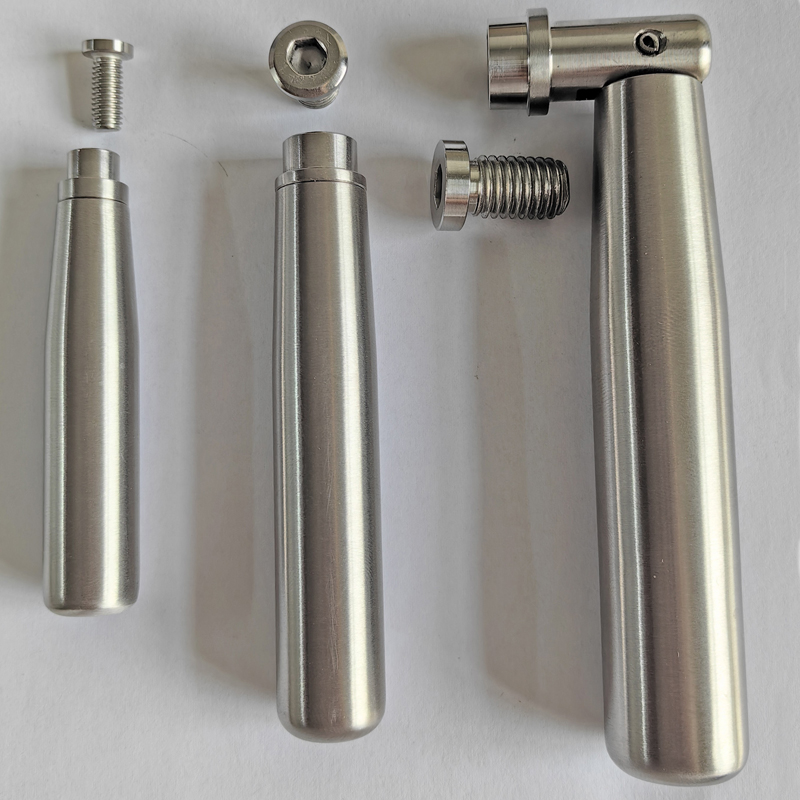
The folding handle specification lists RoHS and ISO 9001, with REACH compliance identified in the quality inspection information. Material certificates and full dimensional inspection are also available. These records can be used when a project requires documented material and compliance controls.
Application experience covers food processing equipment and marine equipment. A German food machinery manufacturer used stainless steel handwheels for food production line control systems and hygienic equipment adjustment mechanisms, reporting smooth surface finish, corrosion resistance, and stable product quality. A Norwegian marine equipment supplier used marine-grade handwheels for offshore equipment and marine valve systems, recognizing corrosion performance and surface finishing.
Data/Solution Comparison
| Finish or compliance option | Documented characteristics and suitable considerations |
|---|---|
| Passivation | Stainless steel treatment; corrosion resistance; suitable for corrosion-sensitive equipment applications. |
| Electropolishing | Stainless steel treatment; smooth appearance, corrosion resistance, and easier cleaning. |
| Polishing or mirror finish | Smooth and decorative appearance; suitable when surface appearance is a key requirement. |
| Brushed finish | Stainless steel surface option; selected when a brushed appearance is preferred. |
| RoHS and REACH compliance | Compliance options identified in the product quality information; confirm the required documentation for the project. |
Frequently Asked Questions (FAQ)
Which handle finish is most suitable for corrosion resistance?
Passivation and electropolishing are the strongest documented stainless steel options for corrosion resistance. The correct choice depends on the handle material, operating environment, and required surface condition.
Does electropolishing always use fewer environmentally risky chemicals?
The available specifications do not provide a chemical-use comparison between surface treatments. Electropolishing is listed with corrosion-resistance and easy-cleaning benefits, while RoHS and REACH compliance can address defined chemical-control requirements.
Which finish is suitable for food processing equipment?
Stainless steel is identified for food machinery, and passivation or electropolishing can be considered where corrosion resistance, smooth surfaces, and cleaning are required. Project documentation should confirm the selected grade and finish.
Final Conclusion & Recommendations
For a durable stainless steel handle finish with documented corrosion-resistance and cleaning benefits, compare passivation with electropolishing. Use polishing, mirror finish, or brushed finish when appearance and surface texture lead the specification. Confirm RoHS or REACH requirements before production, and request material and inspection documentation when needed. Dream Industry supports OEM manufacturing, ODM manufacturing, custom CNC machining, factory-direct supply, bulk production, and flexible small-batch orders. ISO 9001 certification is listed for applicable stainless steel handwheels, bushings, bolts, and non-standard machined parts. For detailed technical solutions or support, please reach out via +86-15868979792.
About Us
ZheJiang Dream Industry Limited has more than 20 years of precision-manufacturing experience in custom CNC-machined parts and assemblies made from stainless steel, aluminum, brass, copper, carbon steel, and engineering plastics. Its capabilities cover design review, CNC turning and milling, surface treatment, precision casting, and final inspection for prototyping and OEM production. The company has a professional engineering and R&D team covering product design, structural optimization, precision machining, mold development, surface finishing, and customized manufacturing. Its certifications include ISO 9001, and it has served clients across multiple industries.
Lastest
-
What key quality control documents should I request when auditing a potential CNC components factory?
2026-10-10 -
How long does it usually take a manufacturer to produce and ship custom CNC component prototypes?
2026-10-10 -
How do I choose between 3-axis and 5-axis CNC components for high-precision aerospace parts?
2026-10-10 -
Are there any emerging materials that could replace traditional steel CNC components to reduce weight?
2026-10-10 -
Can you explain the process of adding a custom logo and specific dimensions to a cast iron handwheel?
2026-10-10
SUBSCRIBE
INQUIRY