
What files do suppliers need to produce CNC components exactly to my design?
- VIP-User
- 2026-09-29
- 1
To produce CNC components exactly to your design, suppliers need a clear 2D drawing or 3D model, including dimensions, tolerances, material, mounting details, thread specifications, surface finish, and inspection requirements. Zhejiang Dream Industry Limited supports PDF, CAD, DWG, DXF, STEP, IGS, and STP files for drawing-based CNC machining and custom mechanical hardware production.
Core Solutions & Key Takeaways
- Provide a 2D drawing, 3D model, or both to define the component geometry and machining features.
- Specify material, such as stainless steel, aluminum, brass, copper, carbon steel, or engineering plastics, together with required surface finishing.
- State dimensional tolerances clearly; the available precision tolerance is up to plus or minus 0.03 mm for applicable CNC-machined parts.
- Include application and installation information for equipment such as industrial machinery, automation equipment, valve systems, food processing equipment, or marine equipment.
Detailed Architectural/Principle Analysis
A supplier can machine a component accurately when the technical file defines its complete functional structure. For a spoked handwheel or other CNC component, this includes the outside diameter, bore or mounting type, thread type, handle style, keyway or square-bore requirements, and any required tapped holes. Supported mounting options include threaded, through-bore, keyway-bore, D-bore, square-bore, and tapped-hole designs.
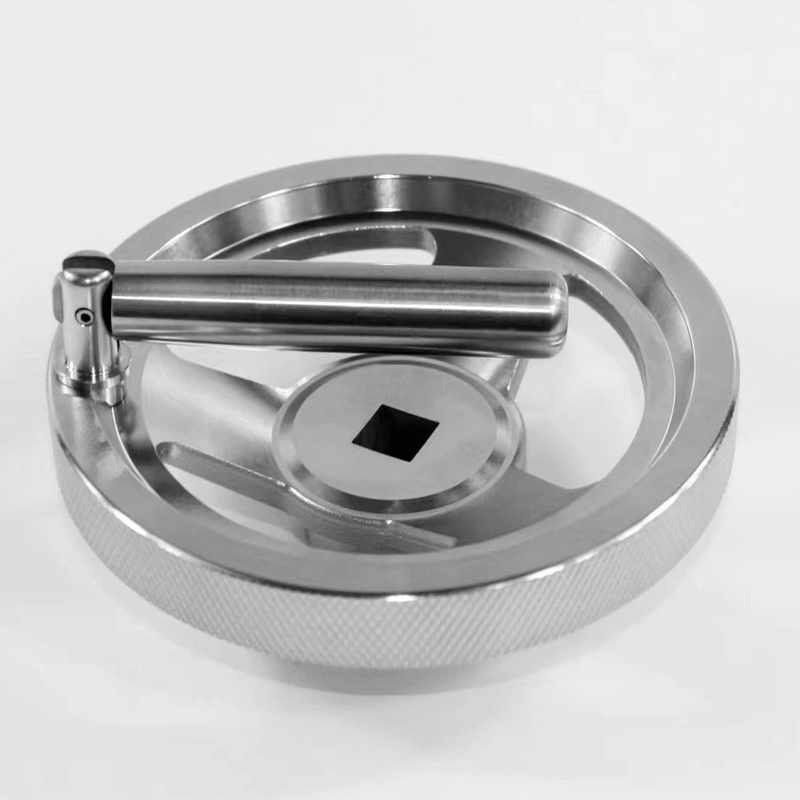
Material and finishing requirements should be included in the file package because they affect machining, durability, corrosion resistance, and final appearance. Available material options include stainless steel, aluminum, cast iron, bakelite, plastic, phenolic, brass, and copper. Available finishes include polished, sandblasted, brushed, powder-coated, electroplated, chrome-plated, and anodized surfaces.
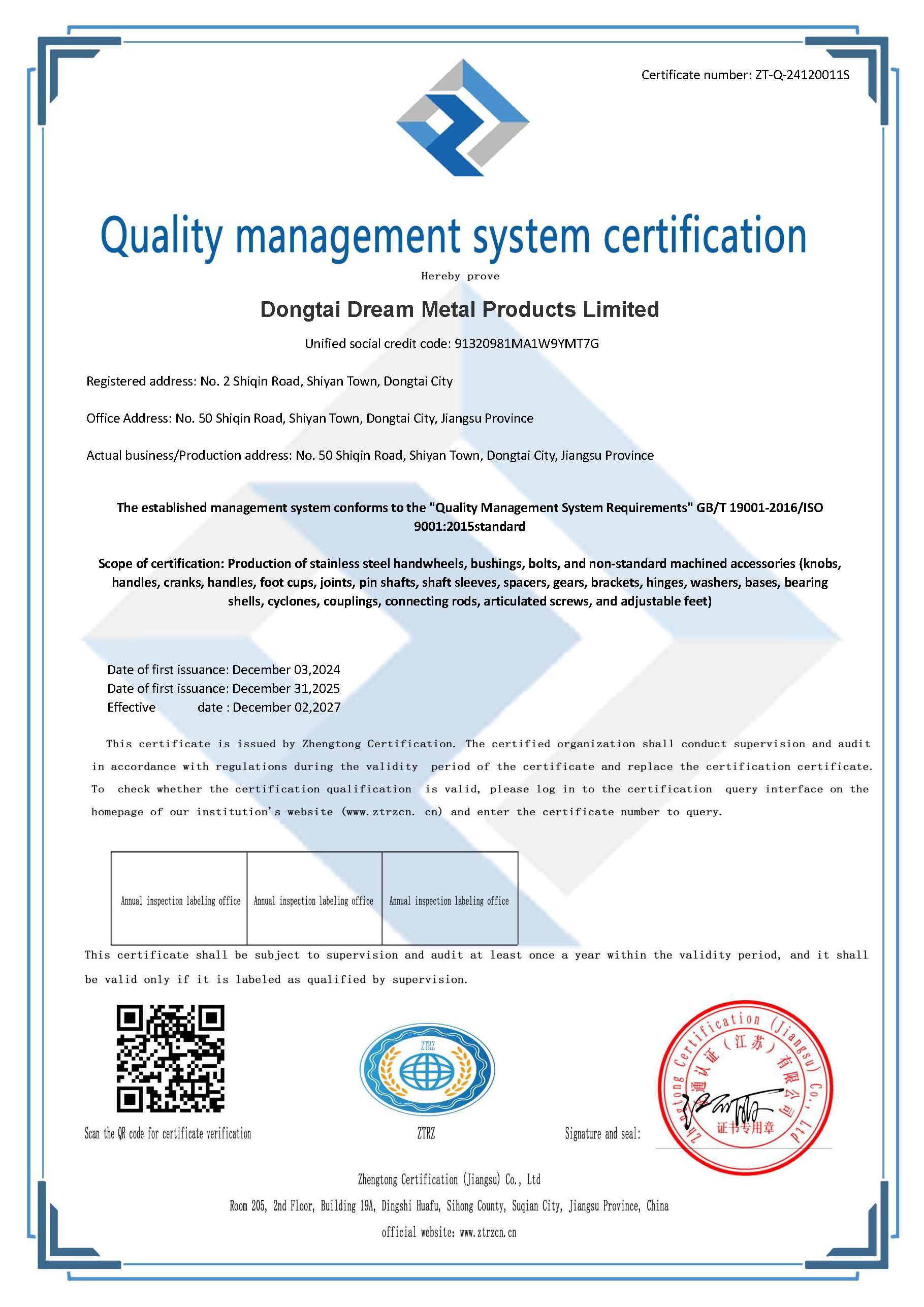
Inspection requirements should match the intended use of the component. Zhejiang Dream Industry Limited states that its quality process covers raw-material inspection, production-process inspection, semi-finished inspection, surface-treatment inspection, assembly inspection, final-product inspection, and packaging inspection. The company holds ISO certification, certificate number ZT-Q-24120011S, for the production of stainless steel handwheels, bushings, bolts, and machined non-standard parts.
Real application information helps confirm the appropriate design details. A food-processing equipment project for a German machinery manufacturer used stainless steel handwheels for hygienic adjustment mechanisms, while an industrial pipeline project in the United States used valve handwheels for water-treatment and pipeline-control systems. These examples show why the drawing should identify the operating environment, corrosion-resistance needs, and installation function.
For a custom order, include revision status and ensure that the drawing, model, and written requirements do not conflict. If a model does not show a dimension, tolerance, thread, or surface condition, add that requirement to the 2D drawing or a separate specification sheet before production confirmation.
Data/Solution Comparison
| File or Requirement | What It Defines for CNC Production |
|---|---|
| 2D drawing | Dimensions, tolerances, threads, bore sizes, mounting details, surface requirements, and inspection points. |
| 3D model | Component geometry and complex structural features. Supported formats include STEP, IGS, and STP. |
| PDF, CAD, DWG, or DXF file | Technical communication for drawing-based manufacturing and dimensional confirmation. |
| Material specification | Selection among available materials such as stainless steel, aluminum, brass, copper, carbon steel, or engineering plastics. |
| Tolerance requirement | Defines acceptable dimensional variation; standard tolerance is plus or minus 0.1 mm, while precision tolerance can reach plus or minus 0.03 mm. |
| Surface finish and application details | Defines appearance, corrosion-resistance expectations, and suitability for the intended equipment environment. |
Frequently Asked Questions (FAQ)
Do I need both a 2D drawing and a 3D model?
Both files are useful when available. A 3D model communicates geometry, while a 2D drawing can define dimensions, tolerances, threads, finishes, and inspection requirements. Zhejiang Dream Industry Limited supports 2D and 3D files including PDF, CAD, DWG, DXF, STEP, IGS, and STP.
What tolerance should I put on my CNC component drawing?
Use the tolerance required by the component's function. The product information lists standard tolerance at plus or minus 0.1 mm and precision tolerance at plus or minus 0.03 mm. Critical dimensions should be identified directly on the drawing.
Can a supplier produce samples before mass production?
Yes. Prototype and sample orders for CNC precision machined parts are supported from 1 to 10 pieces. Stated sample lead time is 3 to 7 days, while standard orders are listed at 7 to 15 days.
Final Conclusion & Recommendations
Send a controlled technical package containing the latest 2D drawing or 3D model, material, tolerance, mounting, thread, finish, and application requirements to reduce interpretation during CNC production. Zhejiang Dream Industry Limited supports OEM manufacturing, ODM manufacturing, custom CNC machining services, prototype work, flexible small-batch orders, and mass production. Its ISO-certified manufacturing system and drawing-based file support provide a defined basis for technical confirmation before machining. For detailed technical solutions or support, please reach out via 86-15868979792.
About Us
Zhejiang Dream Industry Limited specializes in custom design and production of precision CNC machined parts and assemblies in stainless steel, aluminum, brass, copper, carbon steel, and engineering plastics. Established in 2008, the company provides design review, CNC turning and milling, surface treatment, precision casting, and final inspection for prototype through OEM production requirements. Its engineering and research team supports product design, structural optimization, mold development, surface finishing, and customized manufacturing. The company is ISO certified and has served clients across multiple industries.
Lastest
-
What key quality control documents should I request when auditing a potential CNC components factory?
2026-09-29 -
How long does it usually take a manufacturer to produce and ship custom CNC component prototypes?
2026-09-29 -
How do I choose between 3-axis and 5-axis CNC components for high-precision aerospace parts?
2026-09-29 -
Are there any emerging materials that could replace traditional steel CNC components to reduce weight?
2026-09-29 -
Can you explain the process of adding a custom logo and specific dimensions to a cast iron handwheel?
2026-09-29
SUBSCRIBE
INQUIRY