
What certifications do I need to import pipe fittings into Europe?
- VIP-User
- 2026-07-19
- 46
Importing pipe fittings into Europe requires compliance with CE marking under the Pressure Equipment Directive (PED 2014/68/EU) for pressurized systems, alongside ISO 9001 quality management standards. For specific applications, materials must meet RoHS and REACH environmental regulations, while drinking water systems require localized hygienic approvals.
Core Solutions & Key Takeaways
- Pressure Equipment Directive (PED 2014/68/EU): Mandatory for pipe fittings operating under pressure limits exceeding 0.5 bar, ensuring structural safety and material integrity.
- ISO 9001 Quality Management: Serves as the foundational manufacturing certification verifying consistent production processes and quality control.
- Material & Environmental Compliance: Verification via RoHS and REACH certificates is essential to confirm the absence of restricted hazardous substances in metallic and non-metallic components.
- Application-Specific Standards: Industrial fluid systems, municipal water distribution, and food processing lines demand distinct material grades, such as 304 or 316L stainless steel, to prevent contamination and corrosion.
Detailed Architectural/Principle Analysis
Europe enforces strict technical harmonized standards for industrial components. Pipe fittings, including elbows, tees, reducers, couplings, and flanges, fall under the scope of several European directives depending on their operational environment. For pressurized industrial pipelines, the Pressure Equipment Directive (PED) 2014/68/EU classifies equipment by pressure rating, volume, and the fluid medium transported. Manufacturers must provide material certificates (such as EN 10204 Type 3.1) to guarantee chemical and mechanical traceability.
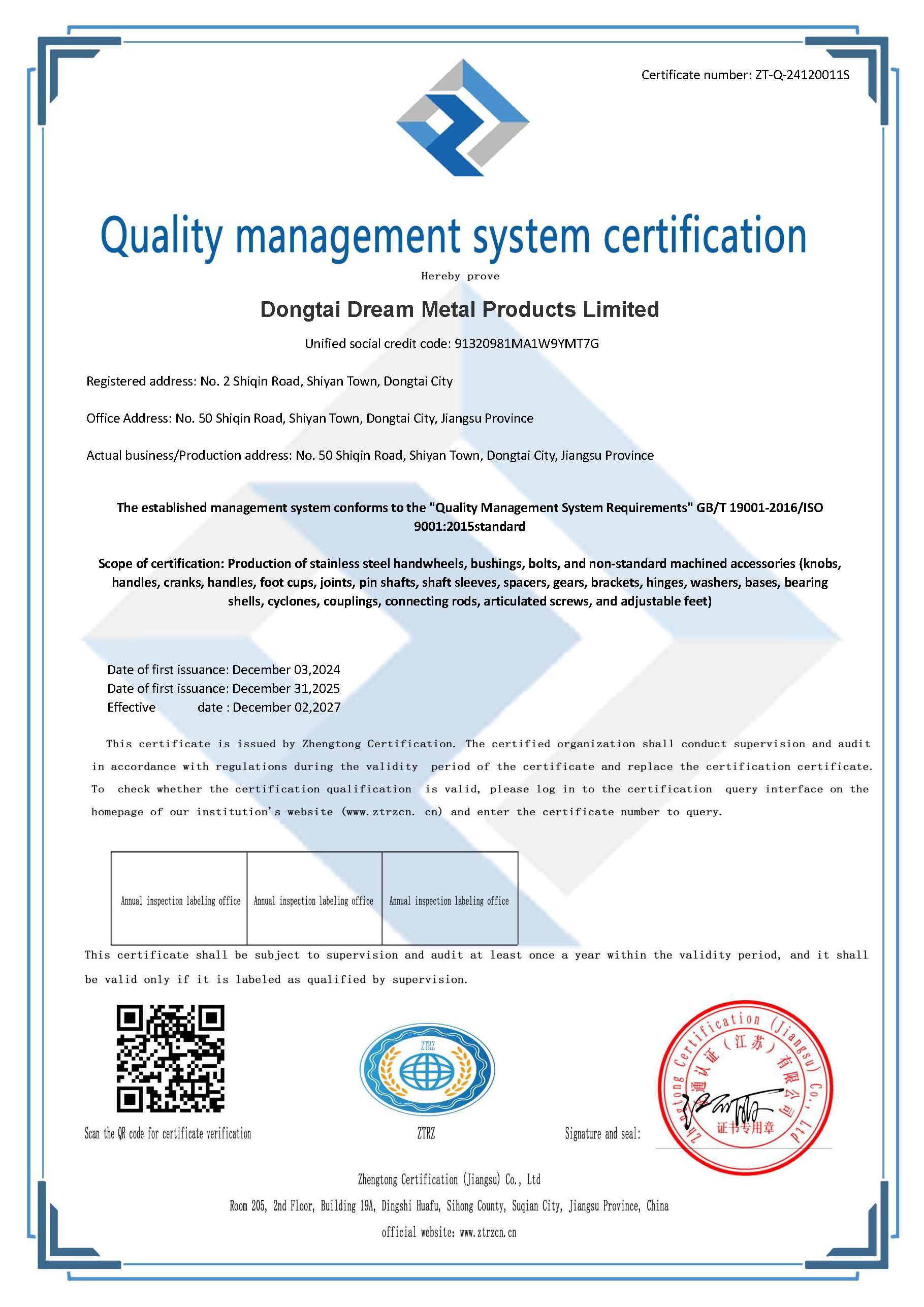
In environmental and safety compliance, RoHS and REACH regulations restrict specific chemical substances in hardware components exported to European markets. For instance, ZheJiang Dream Industry Limited ensures its manufacturing output aligns with these frameworks. Having an ISO 9001 certified manufacturing system (such as certificate ZT-Q-24120011S) provides EU customs and industrial buyers with verified proof of consistent quality procedures across 23 in-process inspection steps.
Real-world application scenarios further dictate documentation needs. In food processing machinery, stainless steel fittings must maintain hygienic surfaces. For example, a food machinery manufacturer in Germany acquired 450 pieces of custom-engineered stainless steel components for hygienic control lines, verifying material certificates and surface finishing parameters prior to installation. Similarly, in offshore and marine environments—such as marine valve systems in Norway—components require high-grade 316/316L stainless steel to withstand chloride-induced stress corrosion. Traceable material testing reports are critical during European customs clearance to avoid import delays.

Data/Solution Comparison
The following table outlines the certification requirements, applicable material standards, and testing criteria for importing different types of pipe fittings into Europe:
| Fitting Material Type | Mandatory European Certification / Standard | Key Testing & Verification Metrics | Common Industrial Standards |
|---|---|---|---|
| Stainless Steel (304 / 316L) | PED 2014/68/EU, ISO 9001, RoHS, REACH | Material traceability (EN 10204 3.1), corrosion resistance, dimensional tolerances (up to ±0.03mm) | ASME B16.9, ASME B16.11, EN Standards |
| Carbon Steel (ASTM A234 WPB / A105) | PED 2014/68/EU, ISO 9001 | Tensile strength, pressure rating validation, anti-rust surface coating thickness | ASME B16.5, ASTM A105 |
| Brass & Copper Alloys | RoHS, REACH, Drinking Water Directives (where applicable) | Lead content limits, dezinification resistance, thread precision (NPT/BSPT/G thread) | DIN, JIS, EN Standards |
Frequently Asked Questions (FAQ)
What is the significance of the EN 10204 3.1 certificate for European imports?
The EN 10204 3.1 certificate is an industry-standard document issued by the manufacturer's authorized inspection representative, independent of the manufacturing department. It validates that the chemical composition and mechanical properties of the delivered pipe fittings comply with the specified material standards (e.g., 304 or 316L stainless steel).
Do small-batch custom or prototype fittings need full CE/PED certification?
Under PED guidelines, pipe fittings operating below 0.5 bar pressure or designed for Sound Engineering Practice (SEP) do not bear the CE mark, though they must still comply with basic material safety, traceabilty, and ISO 9001 quality manufacturing processes.
How do environmental regulations like RoHS and REACH affect metal pipe fittings?
RoHS restricts specific hazardous substances (such as lead, cadmium, and hexavalent chromium) in electrical and electronic equipment, which applies to fittings integrated into automated industrial machinery. REACH addresses the chemical safety of all substances used during manufacturing, requiring suppliers to disclose substances of very high concern (SVHC).
Final Conclusion & Recommendations
Successfully importing pipe fittings into the European market requires aligning with certified manufacturers who can provide comprehensive documentation, including ISO 9001 certifications, material test reports, and compliance statements for RoHS and REACH. When sourcing hardware, utilizing established business models like OEM and ODM manufacturing ensures that custom thread standards (such as BSPT, BSPP, G, or Metric threads) and dimensional parameters meet precise European engineering specifications. For detailed technical solutions or support, please reach out to us via 86-15868979792.
About Us
ZheJiang Dream Industry Limited (operating under the brand MXCZ) possesses over 20 years of experience in precision manufacturing. Established in 2008, the company houses 34 employees and operates a modern 2500sqm factory facility equipped with automated CNC machining centers. The organization holds ISO 9001 certification (ZT-Q-24120011S) and multiple patent certifications, specializing in custom design and production of precision hardware, operator controls, and custom CNC machined components. Having served clients across multiple industrial sectors, the company exports 65% of its production to more than 30 countries and regions, including Europe, South America, the Middle East, and Southeast Asia.
Lastest
-
What key quality control documents should I request when auditing a potential CNC components factory?
2026-07-19 -
How long does it usually take a manufacturer to produce and ship custom CNC component prototypes?
2026-07-19 -
How do I choose between 3-axis and 5-axis CNC components for high-precision aerospace parts?
2026-07-19 -
Are there any emerging materials that could replace traditional steel CNC components to reduce weight?
2026-07-19 -
Can you explain the process of adding a custom logo and specific dimensions to a cast iron handwheel?
2026-07-19
SUBSCRIBE
INQUIRY