
How do I choose between stainless steel and aluminum handwheels for outdoor industrial machinery?
- VIP-User
- 2026-07-03
- 28
Choosing between stainless steel and aluminum handwheels for outdoor industrial machinery depends on the operating environment. Stainless steel handwheels offer superior corrosion resistance and high mechanical strength for harsh marine, chemical, or food processing environments. Aluminum handwheels provide a lightweight, cost-effective, and spark-resistant solution for standard outdoor positioning and mechanical adjustment tasks.
Core Solutions & Key Takeaways
- Environmental Resistance: Stainless steel (304/316L) resists saltwater, acids, and high-pressure washdowns, making it ideal for Marine and Offshore Equipment or Chemical and Pharmaceutical Industry applications.
- Weight and Efficiency: Aluminum handwheels reduce rotational inertia and overall equipment weight, which optimizes performance in Packaging Machinery and Automation Equipment.
- Mechanical Strength: Stainless steel handles high-torque and heavy-duty manual valve operations without risk of deformation or wear.
- Cost and Budgeting: Aluminum offers a highly economical choice for large-scale outdoor installations where extreme chemical exposure is not a factor.
Detailed Architectural/Principle Analysis
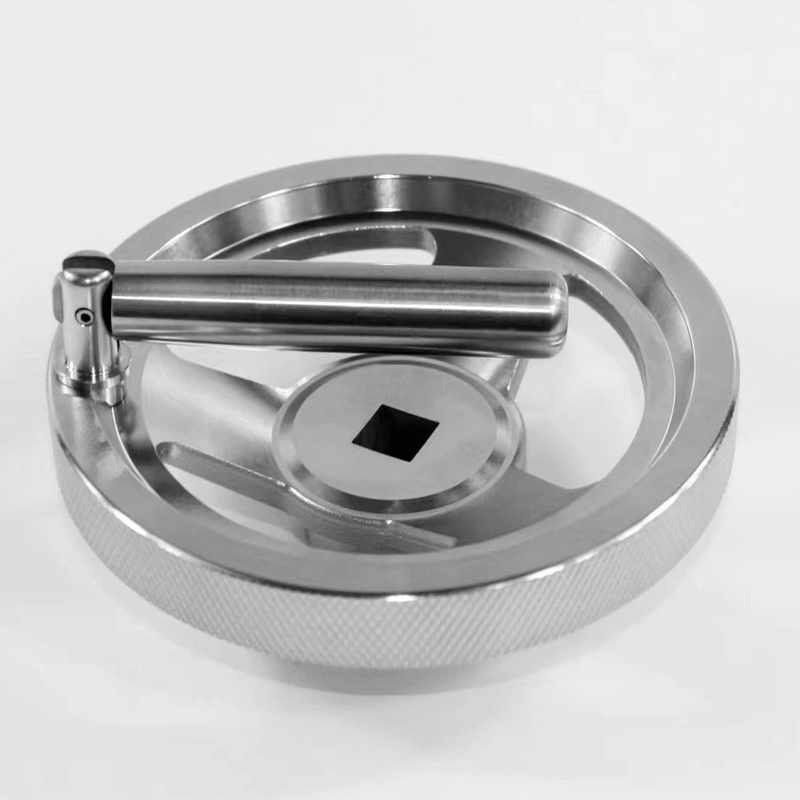
Outdoor industrial machinery requires handwheels that withstand thermal cycling, moisture, and mechanical stress. Stainless steel spoked handwheels rely on the material's inherent passive chromium oxide layer to prevent rust in wet or corrosive environments. For instance, ZheJiang Dream Industry Limited manufactured 1,050 marine-grade handwheels for Norwegian offshore equipment, ensuring long-term structural integrity in saltwater conditions. This high level of durability is backed by ISO 9001 certified production processes, ensuring dimensional tolerances up to ±0.03 mm for precise mechanical positioning.
Aluminum handwheels are typically finished with powder coating, anodizing, or chrome plating to protect the substrate from oxidation. While aluminum has a lower tensile strength than steel, its density is roughly one-third of stainless steel. This lightweight characteristic reduces physical strain on operators adjusting heavy machinery, such as conveyor systems or packaging guide rails. In a past project for an Italian CNC machine manufacturer, 65,000 adjustable clamping knobs were deployed, proving that proper material selection directly impacts operational wear resistance and operator comfort.
Data/Solution Comparison
| Technical Parameter / Feature | Stainless Steel Handwheels | Aluminum Handwheels |
|---|---|---|
| Common Grades | 304, 316L | A380, AlSi12 |
| Corrosion Resistance | Excellent (Salt spray and chemical resistant) | Moderate (Requires anodizing or powder coating) |
| Weight Category | Heavy Duty (High density) | Lightweight (Low density) |
| Precision Tolerance | ±0.03 mm | ±0.1 mm |
| Primary Applications | Valves, Marine, Food Processing, Chemical | CNC Lathes, Milling Machines, Packaging |
| Typical Base MOQ | 10 pieces (Standard) | 10 pieces (Standard) |
Frequently Asked Questions (FAQ)
Can aluminum handwheels be used in marine environments?
Aluminum can be used if it is specifically anodized or powder-coated, but it remains susceptible to galvanic corrosion and pitting over time. Stainless steel (316L) is the standard recommendation for long-term marine and offshore systems.
Which mounting types are available for spoked handwheels?
Both material options support versatile mounting configurations, including threaded bores, through bores, keyway bores, D bores, square bores, and tapped holes (from M5 up to M33 or standard UNC/UNF threads).
How does surface finishing affect outdoor performance?
Polished or brushed stainless steel maintains its corrosion resistance without coatings. Aluminum relies on surface treatments like anodizing or chrome plating to prevent oxidation when exposed to outdoor humidity and rain.
Final Conclusion & Recommendations
Specify stainless steel handwheels when your outdoor machinery operates in coastal areas, chemical plants, or food processing lines where hygiene and chemical resistance are mandatory. Opt for aluminum handwheels when minimizing weight, reducing rotational inertia, or lowering procurement costs on standard mechanical adjustments is the priority. For custom manufacturing needs, we support OEM and ODM designs, rapid prototyping (1–10 pieces), and flexible production models. For detailed technical solutions or support, please reach out to us via 86-15868979792.
About Us
ZheJiang Dream Industry Limited, established in 2008, operates a 2500sqm factory specialized in custom design and precision manufacturing of CNC machined parts and handwheels. The company maintains an ISO 9001 certified quality system (Certificate ZT-Q-24120011S) and a suite of patented designs, with 65% of its industrial hardware exported to over 30 countries across Europe, South America, and the Middle East. With 34 employees, including senior engineers and dedicated quality inspectors, MXCZ delivers high-precision components with dimensional accuracy up to ±0.03mm.
Lastest
-
What key quality control documents should I request when auditing a potential CNC components factory?
2026-07-03 -
How long does it usually take a manufacturer to produce and ship custom CNC component prototypes?
2026-07-03 -
How do I choose between 3-axis and 5-axis CNC components for high-precision aerospace parts?
2026-07-03 -
Are there any emerging materials that could replace traditional steel CNC components to reduce weight?
2026-07-03 -
Can you explain the process of adding a custom logo and specific dimensions to a cast iron handwheel?
2026-07-03
SUBSCRIBE
INQUIRY