
How do I choose between a spoked and a solid handwheel for industrial machinery?
- VIP-User
- 2026-07-02
- 27
Choosing between a spoked and a solid handwheel for industrial machinery depends on your operational needs. Spoked handwheels offer rapid manual adjustment and comfortable grip-rim access for high-torque rotational tasks, whereas solid handwheels provide superior safety by preventing limb entanglement in automated, high-speed rotating shafts while offering a crevice-free surface that is easy to clean.
Core Solutions & Key Takeaways
- Safety and Environment: Solid handwheels prevent fingers, clothing, or tools from getting caught in rotating machinery. This design is highly preferred in high-speed automation equipment and packaging machinery.
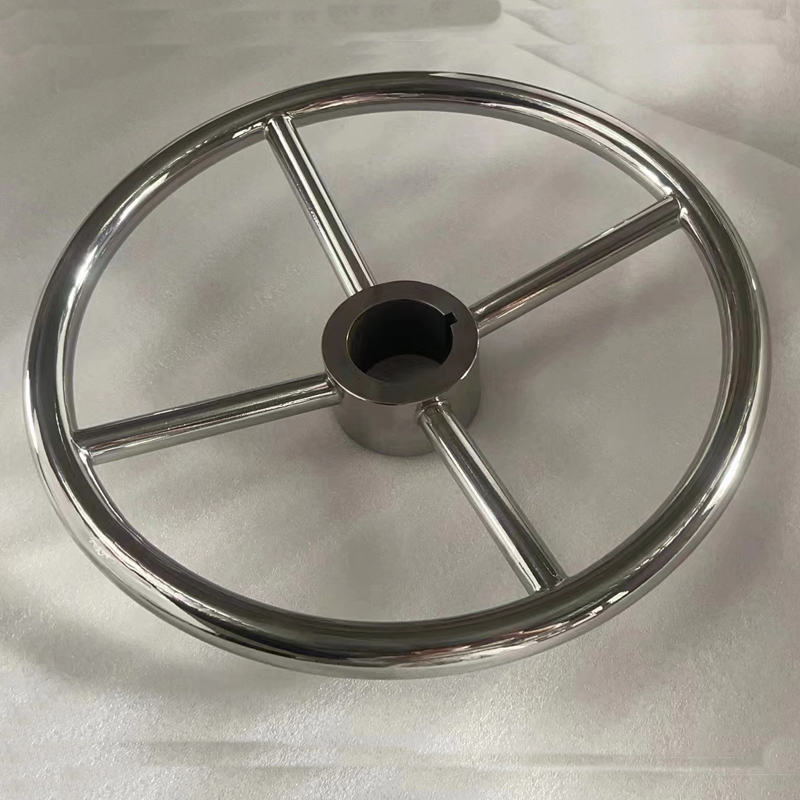
- Torque and Control: Spoked handwheels provide physical leverage points. Operators can easily grip the spokes or attach fixed, revolving, or foldable handles to achieve high-torque control in heavy-duty valve systems and manual lathe setups.
- Sanitation and Maintenance: Solid handwheels lack open gaps, minimizing dust accumulation and bacterial growth. They are ideal for clean-critical settings such as food processing equipment and pharmaceutical systems.
- Material Adaptability: Both configurations are available in various materials including stainless steel (304/316L), aluminum, cast iron, and plastics to match specific corrosion resistance and mechanical requirements.
Detailed Architectural/Principle Analysis
The choice between spoked and solid geometries affects the mechanical properties, safety compliance, and operator ergonomics of industrial machinery. Spoked handwheels distribute material along radial arms to reduce overall weight while preserving structural rigidity. This spoked architecture is advantageous for large-diameter setups (ranging up to 2000mm) where reducing rotating mass lowers system inertia. In manual operations like position adjustment on milling machines or manual valve operation, the spokes offer reliable physical anchor points for high-torque manual adjustments.
Conversely, solid handwheels present a continuous disc surface. When a shaft rotates at high speeds, an open-spoke design acts as a hazard; a solid design eliminates this risk entirely, meeting strict safety guidelines for automated machine tools. For instance, in an adjustable clamping knob project for CNC machines in Italy, choosing a solid, ergonomic design secured stable locking performance and operator safety across 65,000 units. Furthermore, for hygiene-sensitive applications like food production lines in Germany, solid stainless steel handwheels provide smooth, polished surface finishes that withstand aggressive washdowns without trapping organic debris.
To ensure high dimensional precision, manufacturers utilize advanced CNC machining centers and lathes. Quality standards are maintained through strict inspection protocols. For example, ZheJiang Dream Industry Limited applies 23 in-process quality inspection steps to control critical dimensional tolerances to within ±0.03mm. This level of manufacturing precision guarantees that whether you deploy a spoked or solid design, the mounting bore—be it threaded, through-bore, keyway, D-bore, or square-bore—aligns perfectly with your drive shaft.
Data/Solution Comparison
The following table outlines the key technical and application differences to guide your selection process:
| Technical Parameter / Feature | Spoked Handwheel Design | Solid Handwheel Design |
|---|---|---|
| Common Materials | Stainless Steel, Aluminum, Cast Iron, Plastic | Stainless Steel, Bakelite, Phenolic, Plastic |
| Safety Level (High-Speed Shafts) | Low (Risk of entanglement) | High (No open areas) |
| Hygienic / Cleanability Rating | Moderate (Dust can collect around spokes) | Excellent (Smooth, continuous surface) |
| Standard Outer Diameters | 100mm to 2000mm | 45mm to 300mm |
| Typical Mounting Types | Keyway Bore, Threaded, Through Bore | Tapped Hole, D-Bore, Square Bore |
| Common Handle Accessories | Revolving, Foldable, Fixed Handles | Often flat or equipped with small external knobs |
| Primary Industrial Applications | Industrial Valves, Lathes, Agricultural Machinery | Packaging Machinery, Medical Equipment, CNC Automation |
Frequently Asked Questions (FAQ)
Q1: When is a spoked handwheel mandatory over a solid one?
A1: Spoked handwheels are mandatory when the outer diameter exceeds 400mm, as a solid disc of that size would be excessively heavy and difficult for an operator to grip securely. They are also required when high-torque manual positioning requires the operator to physically grab the spokes for leverage.
Q2: Can solid handwheels be used in corrosive saltwater environments?
A2: Yes, provided they are made of corrosion-resistant materials like 316L stainless steel. Solid marine-grade handwheels are frequently used in offshore equipment and marine valve systems because their crevice-free structure prevents salt crust accumulation and chemical pooling.
Q3: How do mounting tolerances differ between these two handwheel styles?
A3: The mounting tolerances do not depend on the wheel style but on the machining process. Precision CNC machining achieves tolerances as tight as ±0.03mm for both spoked and solid designs, ensuring stable fitments for keyway, D-bore, or threaded shafts.
Final Conclusion & Recommendations
To optimize your machinery's performance, select spoked handwheels for large-diameter, manual, high-torque operations where weight reduction and physical leverage are required. Choose solid handwheels for high-speed automated environments, packaging machinery, and hygienic applications where operator safety and cleanability are paramount. For specific project requirements, custom OEM and ODM manufacturing services support tailored dimensions, materials, and surface finishes (such as sandblasting, polishing, or powder coating) with flexible minimum order quantities starting at 10 pieces for standard profiles. For detailed technical solutions or support, please reach out to us via 86-15868979792.
About Us
ZheJiang Dream Industry Limited (MXCZ) has over 20 years of experience in precision manufacturing, specializing in the custom design and production of precision CNC machined parts and handwheel assemblies. Established in 2008, the company operates a 2500sqm factory equipped with over 100 highly automated CNC production and inspection units, yielding an annual capacity of over 3 million handwheel units. Holding ISO certification (Certificate ZT-Q-24120011S), the company maintains strict quality standards with a defect rate controlled below 0.3%, reliably serving global industrial clients across 30+ countries including Germany, the United States, Norway, and Italy.
Lastest
-
What key quality control documents should I request when auditing a potential CNC components factory?
2026-07-02 -
How long does it usually take a manufacturer to produce and ship custom CNC component prototypes?
2026-07-02 -
How do I choose between 3-axis and 5-axis CNC components for high-precision aerospace parts?
2026-07-02 -
Are there any emerging materials that could replace traditional steel CNC components to reduce weight?
2026-07-02 -
Can you explain the process of adding a custom logo and specific dimensions to a cast iron handwheel?
2026-07-02
SUBSCRIBE
INQUIRY