
Can I use zinc-plated wedge anchors in outdoor concrete structures?
- VIP-User
- 2026-07-20
- 32
Using zinc-plated wedge anchors in outdoor concrete structures is not recommended. Outdoor environments expose anchors to moisture, temperature fluctuations, and atmospheric pollutants, which rapidly corrode the thin zinc plating and lead to structural failure. High-performance outdoor installations require stainless steel wedge anchors, such as grade 304 for general outdoor use or grade 316 for marine and highly corrosive environments.
Core Solutions & Key Takeaways
- Material Selection is Critical: Zinc-plated carbon steel anchors lack the necessary corrosion resistance for long-term outdoor exposure. Stainless steel is the industrial standard for exterior concrete fastening.
- Environmental Matching: Grade 304 stainless steel suits standard outdoor construction, handrails, and HVAC systems. Grade 316 stainless steel is required for coastal projects, marine engineering, and chemical plants due to its superior salt and chloride resistance.
- Base Material Compatibility: Stainless steel wedge anchors are engineered specifically for solid concrete, reinforced concrete, and grout-filled masonry. They should not be used in brick, hollow block, drywall, or wood.
- Application Scope: Typical outdoor structural applications include fixing steel structures, curtain walls, guardrails, stair railings, utility pipe supports, and heavy machinery bases.
Detailed Architectural/Principle Analysis
Wedge anchors operate on expansion-based mechanical locking. When the nut is tightened to the specified installation torque, the expansion clip expands against the walls of the drilled hole, generating high holding power and pull-out resistance. In outdoor concrete structures, concrete can retain moisture, creating a highly corrosive micro-environment inside the drill hole. Zinc-plated coatings quickly degrade under these conditions, leading to rust, volume expansion of the anchor body, concrete spalling, and eventual loss of tension load capacity.
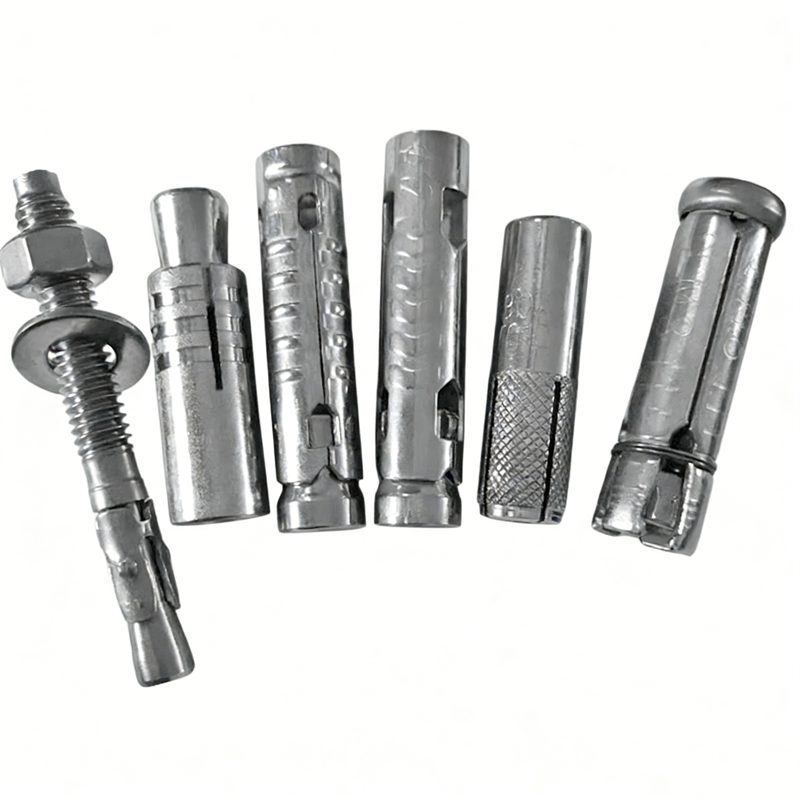
To prevent catastrophic failure, structural designs utilize stainless steel wedge anchors manufactured under strict quality systems like ISO 9001 and RoHS compliance. For example, grade 316 stainless steel contains molybdenum, which provides exceptional resistance to pitting and crevice corrosion in saltwater and chemical processing environments. Real-world applications, such as a marine-grade handwheel and valve system project for offshore equipment in Norway, demonstrate that choosing the correct grade of stainless steel ensures reliable performance and an extended service life under harsh marine conditions.
Data/Solution Comparison
| Parameters / Features | 304 Stainless Steel Wedge Anchors | 316 Stainless Steel Wedge Anchors |
|---|---|---|
| Corrosion Resistance | Excellent (Standard humid environments) | Superior (Saltwater, chloride, chemical environments) |
| Material Standards | ASTM F593, DIN 1.4301 | ASTM A276, DIN 1.4401 / 1.4404 |
| Key Applications | Outdoor fences, handrails, light poles, HVAC | Marine engineering, coastal projects, wastewater plants |
| Standard Tolerances | ±0.1 mm | ±0.1 mm |
| Base Material Compatibility | Solid concrete, reinforced concrete | Solid concrete, reinforced concrete |
| Drill Hole Diameter | Same as anchor diameter (e.g., M10 anchor = 10mm hole) | Same as anchor diameter |
Frequently Asked Questions (FAQ)
Can I use stainless steel wedge anchors in hollow brick or block?
No. Stainless steel wedge anchors rely on the expansion force against solid concrete walls to secure their hold. They are not recommended for brick, hollow block, drywall, or wood, as these materials cannot support the expansion forces and will crack or fail to provide holding power.
What is the standard installation process for a concrete wedge anchor?
First, drill a hole of the same diameter as the anchor. Second, clean the hole thoroughly of all dust and debris. Third, insert the anchor through the fixture into the hole. Finally, tighten the nut to the specified torque value to expand the clip and complete the permanent anchoring process.
What sizes of stainless steel wedge anchors are available?
Standard metric diameters range from M6 to M24 (and imperial sizes from 1/4” to 1”), with lengths ranging from 40 mm to 200 mm. Custom lengths, threads, and configurations can also be manufactured based on specific engineering drawings.
Final Conclusion & Recommendations
For any outdoor concrete fastening project, substituting zinc-plated anchors for stainless steel compromises safety and structural integrity. Selecting either 304 or 316 stainless steel wedge anchors ensures high tensile strength, shear strength, and long-term vibration resistance. When purchasing these critical hardware components, working with an experienced manufacturer that supports flexible production models—such as custom CNC machining, OEM/ODM manufacturing, and bulk production—helps ensure compliance with strict dimensional tolerances and mechanical property requirements. For detailed technical solutions or support, please reach out to us via 86-15868979792.
About Us
ZheJiang Dream Industry Limited, established in 2008, has over 20 years of experience in precision manufacturing and employs 34 staff members at its 2500sqm facility. We specialize in the custom design and production of precision CNC machined parts, assemblies, and industrial hardware, utilizing a manufacturing system certified under ISO ZT-Q-24120011S and holding multiple patent certifications. The company has served global clients across food processing, marine engineering, and industrial valve manufacturing, exporting 65% of its production to over 30 countries and regions.
Lastest
-
What key quality control documents should I request when auditing a potential CNC components factory?
2026-07-20 -
How long does it usually take a manufacturer to produce and ship custom CNC component prototypes?
2026-07-20 -
How do I choose between 3-axis and 5-axis CNC components for high-precision aerospace parts?
2026-07-20 -
Are there any emerging materials that could replace traditional steel CNC components to reduce weight?
2026-07-20 -
Can you explain the process of adding a custom logo and specific dimensions to a cast iron handwheel?
2026-07-20
SUBSCRIBE
INQUIRY