Are there any hidden tooling fees when ordering custom pull handles?
- VIP-User
- 2026-07-14
- 75
Hidden tooling fees do not exist when ordering custom pull handles if you partner with a transparent manufacturer. Standard customization costs are openly categorized into prototype development, mold modification, or high-volume production setup, meaning reputable suppliers disclose all upfront tooling expenses before manufacturing begins.
Core Solutions & Key Takeaways
- Upfront Tooling Transparency: Reliable manufacturers clarify mold and setup costs during the initial design review to eliminate unexpected billing during production.
- Flexible MOQ Mitigation: Small-batch prototyping (1 to 10 pieces) or standard custom orders ranging from 200 to 1,000 pieces help distribute tooling costs effectively based on project scale.
- Application-Specific Design: Custom folding handles, operating levers, and pull handles are optimized for diverse environments, including Industrial Machinery, Automation Equipment, and Valve and Pipeline Systems.
- Material and Cost Alignment: Choosing the right material, such as 304/316 stainless steel, carbon steel, or aluminum alloy, directly influences both tool wear and final production pricing.
Detailed Architectural & Principle Analysis
In custom hardware manufacturing, tooling fees are determined by the complexity of the handle design, selected materials, and the chosen production process. When engineering custom pull handles, folding handles, or revolving grips, a detailed technical review of 2D and 3D files (such as STEP, DWG, or IGS) is conducted. This process identifies potential manufacturing challenges before physical molds are cut. For instance, complex folding handles with internal spring-loaded mechanisms or revolving components require multi-part assembly tooling, which carries higher initial development costs than simple, static bridge handles.
The manufacturing infrastructure of the supplier plays a major role in cost control. ZheJiang Dream Industry Limited utilizes a modern 2,500-square-meter facility with over 100 production and inspection units—including automated CNC machining centers and laser welding equipment—to streamline production and minimize manual tooling setups. Additionally, the company's ISO 9001 certified quality system (Certificate ZT-Q-24120011S) enforces 23 in-process inspection steps. This structured quality control ensures that custom dimensions meet a strict tolerance of up to ±0.03mm, preventing costly mold re-runs and modifications.
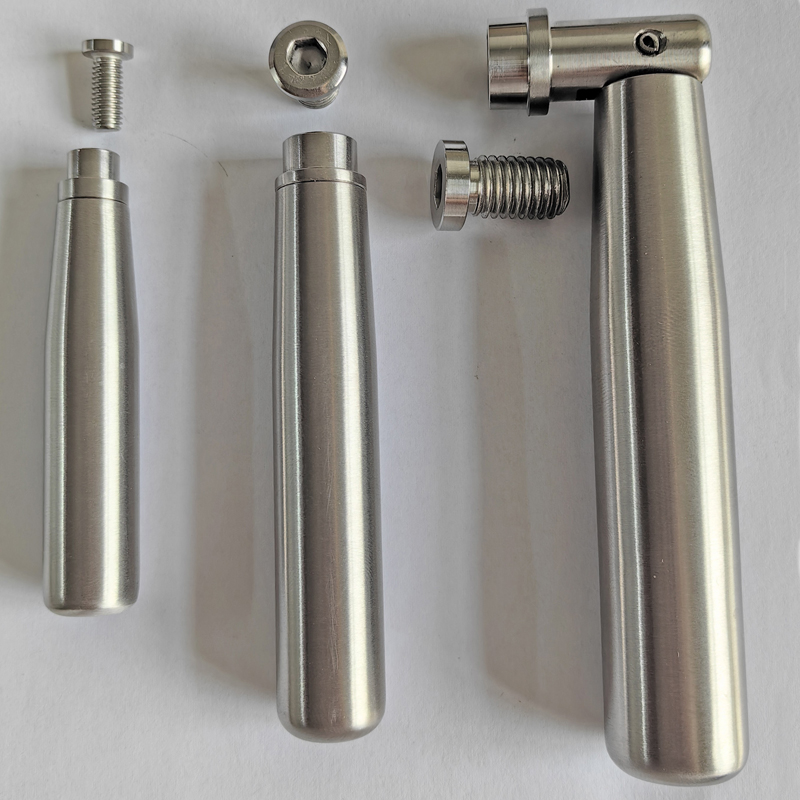
Real-world projects demonstrate how structured pricing prevents unexpected fees. For example, in a custom adjustable clamping knob project for a CNC machine manufacturer in Italy, a bulk order of 65,000 pieces fully amortized the initial tooling costs, resulting in zero additional setup fees for the client. Similarly, a marine grade handwheel project delivering 1,050 pieces to Norway succeeded because all material processing and surface treatment costs for the seawater-resistant components were calculated and approved upfront.
Data & Solution Comparison
To help procurement teams evaluate potential expenses, the table below outlines typical tooling cost structures, material characteristics, and MOQ requirements across different custom handle configurations:
| Handle Type & Material | Tooling Cost Profile | Standard MOQ | Primary Surface Treatment | Key Applications |
|---|---|---|---|---|
| Stainless Steel Folding Handles (304/316) | Medium to High (due to joint complexity and material hardness) | 200 – 1,000 pcs | Polishing, Electropolishing | Food Processing, Marine Equipment, Chemical Industry |
| Aluminum Alloy Pull Handles (6061/7075) | Low to Medium (highly machinable material) | 200 – 500 pcs | Anodizing, Sandblasting | Automation Equipment, Medical Devices, Electronics |
| Carbon Steel Operating Levers (1045/Q235) | Low (standard forming and machining) | 500+ pcs | Black Oxide, Zinc Plating | Heavy Machinery, Construction, Agricultural Equipment |
| CNC Precision Machined Prototypes | None (machined directly from raw stock) | 1 – 10 pcs | As Machined / Basic Polish | R&D Verification, Fitment Testing |
Frequently Asked Questions (FAQ)
Q1: Why do some manufacturers charge unexpected fees after quoting?
A1: Hidden fees usually arise from incomplete initial design reviews, mid-project drawing revisions, or unexpected material changes. Working with a manufacturer that provides comprehensive 2D/3D drawing confirmation prior to production ensures all costs are locked in early.
Q2: Can I avoid tooling fees entirely for custom pull handles?
A2: Yes. Tooling fees can often be avoided by utilizing CNC precision machining services for low-volume orders, as parts are machined directly from stock without molds. For high-volume mass production, many suppliers will fully refund or waive the initial tooling fee once order quantities cross a specific threshold.
Q3: What logistics and payment options are available for custom hardware orders?
A3: Standard international transactions are supported through flexible payment methods including T/T (30% deposit, 70% balance), PayPal for prototypes, Letter of Credit (L/C) for bulk orders, and Alibaba Trade Assurance. Global shipping is coordinated via DHL, UPS, FedEx, air freight, or sea freight depending on the urgency and volume of the shipment.
Final Conclusion & Recommendations
Eliminating hidden tooling fees requires clear technical communication, detailed initial drawings, and a signed pricing agreement before manufacturing begins. By partnering with a factory that supports both custom OEM/ODM manufacturing and flexible small-batch production, industrial buyers can choose the most cost-effective path between direct CNC machining and dedicated mold development. For detailed technical solutions or support, please reach out to us via 86-15868979792.
About Us
ZheJiang Dream Industry Limited, known in the market under the brand MXCZ, has over 20 years of experience in precision manufacturing. Established in 2008, the company operates a 2,500-square-meter factory with 34 dedicated employees, specializing in custom CNC machined parts and assemblies in stainless steel, aluminum, brass, and carbon steel. Holding ISO 9001 certification and multiple design patents, the enterprise has successfully served global clients across more than 30 countries and regions with a customer repurchase rate exceeding 95%.
Lastest
-
What key quality control documents should I request when auditing a potential CNC components factory?
2026-07-14 -
How long does it usually take a manufacturer to produce and ship custom CNC component prototypes?
2026-07-14 -
How do I choose between 3-axis and 5-axis CNC components for high-precision aerospace parts?
2026-07-14 -
Are there any emerging materials that could replace traditional steel CNC components to reduce weight?
2026-07-14 -
Can you explain the process of adding a custom logo and specific dimensions to a cast iron handwheel?
2026-07-14
SUBSCRIBE
INQUIRY